Your Cart is Empty


From Stage to Stone: The Colourful Legacy of Harlequin Jewellery
Harlequin jewellery is one of those rare styles where history, theatre, and craftsmanship collide in the most joyful way. Bright, playful, and uniquely eclectic, it carries a story that begins not in a jewellery workshop, but on the stage.

The Origins: 16th Century Italy & The World of Theatre
The roots of Harlequin jewellery trace back to 16th-century Italy, in the vibrant world of commedia dell’arte, a form of improvised theatre that brought stock characters to life with exaggerated personalities and striking costumes & masks.
At the centre of it all was Harlequin (Arlecchino), a mischievous, quick-witted servant known for his agility, humour, and charm. His costume became iconic: a patchwork of brightly coloured diamond shapes stitched together in a rhythmic, almost kaleidoscopic pattern.
This bold visual language of contrasting colours, playful geometry, and a sense of movement would become the foundation of what we now recognise as the Harlequin aesthetic.

From Costume to Craft: The Evolution into Jewellery
By the Georgian era (1714–1837), jewellers began translating this theatrical vibrancy into wearable art. Rather than fabric, they used gemstones, arranging a variety of colours side by side to mimic the lively patchwork of Harlequin’s costume.
These early pieces often featured:
- Foil-backed gemstones to intensify colour and light
- Closed-back settings, typical of the period
- A mix of stones such as garnet, topaz, amethyst, peridot, and paste
The intention wasn’t strict symmetry or matching sets, but rather a harmonious chaos, a deliberate play of colour that felt spontaneous and balanced.
The style carried into the Victorian & Edwardian eras, where sentimentality and symbolism were everything. Multi-gem pieces took on additional meaning, sometimes representing emotions, milestones, or simply a celebration of abundance and individuality. As the motif moved beyond the stage, it found new life in the hands of jewellers across Europe, particularly during the 18th and 19th centuries. Advances in gemstone cutting and sourcing meant a richer palette was suddenly available, allowing artisans to experiment with increasingly intricate arrangements of colour and form.
Rather than strict symmetry, many Harlequin pieces embraced a more fluid, almost painterly composition, each gemstone chosen not just for its hue, but for how it played against the others. The effect is lively yet harmonious, a carefully balanced clash of colour that feels both spontaneous and expertly considered.

The Aesthetic: Controlled Chaos & Colour Play
What sets Harlequin jewellery apart is its refusal to conform.
Unlike traditional fine jewellery which often prioritises uniformity (think matched diamonds or a single dominant stone) Harlequin pieces embrace contrast:
- A spectrum of colours in one composition
- Mixed gemstone types and cuts
- Asymmetry that still feels intentional
It’s not random but rather curated unpredictability.

Why Harlequin Jewellery Still Resonates Today
Centuries later, the appeal of Harlequin jewellery hasn’t faded, in fact, it feels more relevant than ever.
In a world increasingly drawn to individuality and self-expression, these pieces offer something refreshingly different:
- No two are ever quite the same
-They pair effortlessly with modern styling
-They bring colour and personality into everyday wear
For collectors, they hold an added layer of intrigue. Each piece reflects not just craftsmanship, but a lineage of design that stretches back to Renaissance Italy.

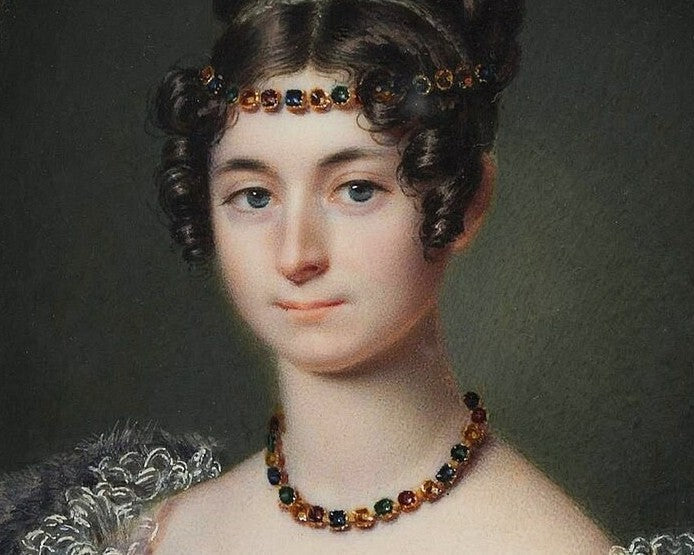
Portrait of Anna Adamowa Czartoryska, 1825 (artist unknown).
A Lasting Legacy
What began as a theatrical costume in 16th-century Italy has evolved into a distinctive jewellery style that celebrates colour, contrast, and creativity.
Harlequin jewellery reminds us that beauty doesn’t always lie in perfection or uniformity, sometimes, it’s found in the unexpected pairing of colours, the tension between order and spontaneity, and the stories woven into each element.
Who would have thought that a playful character from commedia dell’arte would leave such a lasting imprint on the world of jewellery?
And yet, centuries on, the spirit of Harlequin still shines, captured in gemstones, set in gold, and worn as a celebration of individuality.

Edwardian Harlequin Necklace, c1900. R&V 2026