Your Cart is Empty


The Jewellery of the Aesthetic Era 1885 -1901: Art, Intellect & the Beauty of Restraint
There’s a quiet kind of confidence to Aesthetic Era jewellery. Thoughtful, deliberate, and often deeply symbolic, these pieces reflect a moment in history when beauty was pursued not for status, but for its own sake, often referred to as ‘The Cult of Beauty’.
Emerging in the latter half of the 19th century, the Aesthetic Movement was a direct response to the excesses of earlier Victorian design. Where mid-Victorian jewellery leaned heavily into sentimentality and ornate symbolism, the Aesthetic Era offered something altogether more refined, an intellectual and artistic shift toward harmony, simplicity, and the poetic beauty of nature itself.

Photo courtesy Tate Modern
‘Art for Art’s Sake’: The Philosophy Behind the Jewellery.
At the heart of the movement was a simple but radical idea: art does not need to justify itself. Championed by artists such as Oscar Wilde, James McNeill Whistler & Aubrey Beardsley, the Aesthetic Movement rejected moralising narratives and instead embraced beauty as its own purpose. William Morris sought to preserve the spirit of the Middle Ages in the face of the Industrial Revolution. In 1884, inspired by his example, a group of craftsmen formed the Art Workers’ Guild. Two years later, in 1886, a group of artists established the Arts and Crafts Exhibition Society. Together, these organisations set out to captivate the public with their work.
This philosophy naturally found its way into jewellery design. Pieces were no longer required to tell a sentimental story of mourning or love. Instead, they became miniature works of art, balanced, harmonious, and often inspired by the natural world.
There was also a strong influence from Japanese art and design, which had recently entered Europe in a wave of fascination known as Japonisme. Asymmetry, negative space, and stylised natural forms became central to the aesthetic vocabulary.

Aubrey Beardsley
The Peacock Skirt 1893, Line block print on paper (Courtesy Stephen Calloway)

A Victorian Plique-à-Jour Bat Brooch. Circa 1890 (courtesy of Sotheby’s)
Defining Characteristics of Aesthetic Era Jewellery.
Aesthetic Era jewellery (roughly 1885–1900) is instantly recognisable once you know what to look for. It carries a distinct lightness, both visually and philosophically.
Nature, but stylised
Motifs such as bats, birds, butterflies, bamboo, cranes, and flowers appear frequently, but not in the hyper-realistic style of earlier Victorian work. Instead, they are simplified, almost graphic in form, often arranged with a painterly sense of balance.
Japanese influence
Fans, crescents, and asymmetrical compositions reflect the influence of Japanese woodblock prints. Pieces often feel airy and intentionally off-centre, an unusual and striking departure from Western symmetry.
Surface over sparkle
Unlike later periods that celebrate brilliance and fire, Aesthetic jewellery prioritises surface design. Engraving, etching, and repoussé work take centre stage. When gemstones are used, they’re often subtle, think small Rubies, seed Pearls, or Garnets rather than large, dominating stones.
Gold, but quieter
Yellow gold is the dominant metal, often in matte or softly brushed finishes rather than high polish. Silver also appears frequently, particularly in more artistic or experimental pieces.
A sense of restraint
Perhaps the most defining trait: nothing feels excessive. Even at its most decorative, Aesthetic jewellery maintains a sense of control and intention.

Peacock Room designed by Thomas Jeckyll, at the Freer Gallery in Washington, D.C. Photo via Wikipedia
Materials & Craftsmanship: Beauty in the Details.
Craftsmanship in the Aesthetic Era is quietly extraordinary. These are pieces that reward a closer look.
Goldsmiths leaned heavily into techniques that enhanced texture and form, hand engraving, applied wirework, and delicate repoussé created depth without the need for heavy gemstone use. Enamel, when present, was often used sparingly, adding just a hint of colour to an otherwise monochromatic palette.
Seed pearls appear frequently, lending a softness and luminosity that complements the understated designs. Gemstones, when used, tend toward cabochon cuts or smaller faceted stones, never overpowering the composition.
It’s a period where the hand of the maker feels present. You can sense the deliberate choices, the restraint, the artistry.

Aesthetic Era Gold Ruby Earrings and Locket Pendant c1885. Photo courtesy Rock & Vestige
Aesthetic vs. Victorian: A Shift in Mood.
To truly appreciate Aesthetic jewellery, it helps to see it in contrast with what came before.
Mid-Victorian jewellery often carried emotional weight, mourning pieces, symbolic motifs, heavy gold forms, and dark enamels. It was deeply tied to personal narratives and societal conventions.
The Aesthetic Era steps away from this. It feels lighter, more modern, even today. Where Victorian jewellery speaks to you, Aesthetic jewellery invites you to simply observe.
Women were stepping more confidently into public and professional life. In politics, they organised and mobilised, founding groups such as the Primrose League in 1885 and the Women’s Liberal Federation a year later, working with urgency toward the right to vote. At the same time, younger women were attending university, embracing sport, and engaging more fully in leisure culture. Fashion reflected this shift: there was a deliberate flirtation with the playful and slightly subversive, a knowing hint of frivolity that signalled a modern, fin de siècle spirit.
This shift paved the way for the Art Nouveau movement that followed, where nature became even more fluid and expressive.

Votes for women - wikipedia
The End of an Era.
The Victorian era was the reign of Queen Victoria, from 20 June 1837 until her death on 22 January 1901. The era followed the Georgian era and preceded the Edwardian era, and its later half overlaps with the first part of the Belle Époque era of continental Europe.
The wider Royal Family continued to shape fashion in a very real way after the Queen’s passing. The Princess of Wales’ signature dog-collar necklaces and sweeping ropes of pearls were copied across the world. Following Queen Victoria’s death in 1901, King Edward VII and Queen Alexandra carried that influence forward, defining the style of the next era in both jewellery and dress.
Why Aesthetic Era Jewellery Still Resonates.
There’s something remarkably contemporary about Aesthetic jewellery. Its restraint, its focus on form, its rejection of excess, it aligns beautifully with modern tastes.
For collectors, these pieces offer something a little different. They’re not about carat weight or overt luxury. They’re about design, intention, and quiet confidence.
They also carry a certain intellectual charm. Owning an Aesthetic Era piece feels like owning a fragment of a broader cultural shift, a moment when art, design, and philosophy aligned in pursuit of beauty alone.
In a world that often leans toward more, these pieces feel refreshingly, almost rebelliously, just enough.

Princess Alexandra, Jewellery Trendsetter.

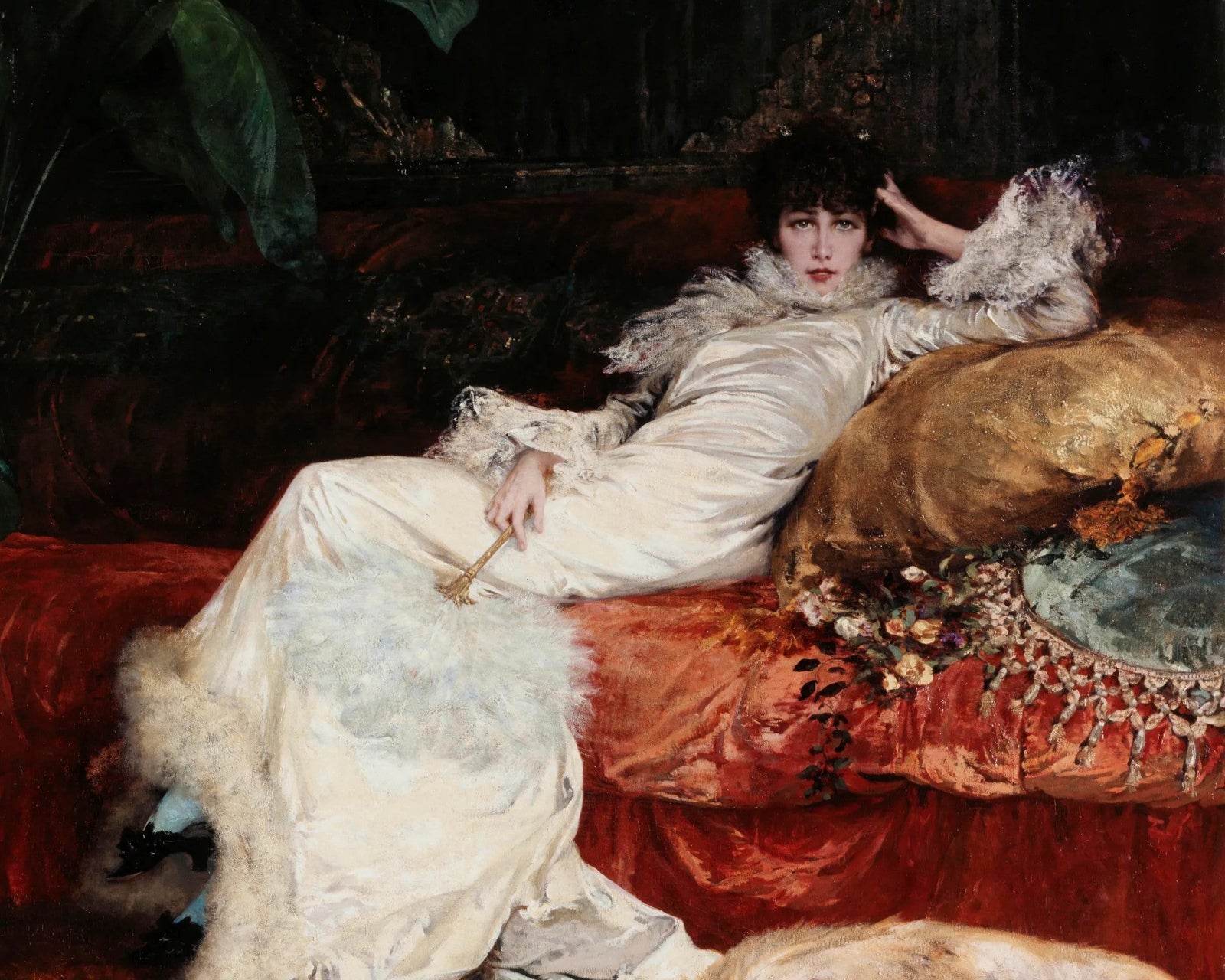
Portrait de Sarah Bernhardt, 1876, Georges Clairin. Courtesy Petit Palais, Paris, France.